

Blue & John Crow Mountains
The Blue and John Crow Mountains National Park is managed for conservation of biological diversity and associated cultural heritage, conservation of ecosystem services such as water supply and for its recreational values. Hence under the International Union for the Conservation of Nature (IUCN) Protected Area Categories, it is a Category II site. Management is guided by a six year management plan prepared by the site’s manager, the Jamaica Conservation and Development Trust (JCDT) using a participatory process and approved by the Natural Resources Conservation Authority (NRCA). The management plan follows national and international recommendations with respect to the information included and the programmes implemented.
The first Management Plan for the BJCMNP was prepared in 1993 when the National Park was first designated. The current Management Plan is for the period 2011 – 2016 and is based on an evaluation of the 2005 – 2010 Plan. In general, programme goals remain the same with specific objectives being set every five years to aid in achieving the longer term goals and over-arching goal, mission and vision for the Blue and John Crow Mountains National Park.
| Programme Goal To maintain and enhance the remaining area of closed broadleaf forest and component species of plants and animals which exist in the Blue and John Crow Mountains. |
|
|---|---|
| Objective 1 | To rehabilitate and maintain at least 120 hectares of degraded forest on shale and limestone in the priority intervention areas. |
| Objective 2 | To successfully propagate and supply 22,000 native seedlings for use in forest rehabilitation, including at least 4 additional native species one of which is threatened. |
| Objective 3 | To promote research that will inform park management, but will not threaten the resources. |
| Objective 4 | To implement specific conservation programmes for conservation targets, as relevant information becomes available. |
Between 2005 and 2009, the Conservation Progrmme goal was achieved as:-
- the targeted area was maintained (according to Forestry Department assessment of photography from a helicopter reconnaissance) and
- enhanced with 42ha rehabilitated by JCDT and about 38ha reforested by the Lions Club and the Forestry Department.
Evidence from the National Park’s Monitoring and Evaluation Programme, indicates that species populations of plants and animals have remained stable or even increased. The use of native species and eradication of alien invasive plant species has increased the biodiversity in targeted areas of the National Park.
JCDT’s current conservation work in the BJCMNP is based on the pioneering work of Dr. Shauna Lee Chai. This was prior to her being awarded a Bill and Melinda Gates Scholarship to pursue Ph.D. studies in forest ecology at Cambridge University, where she obtained this degree based on studies in the BJCMNP. Between 2004 – 2005, with funding from the Rufford Foundation and Strawberry Hill Hotel and Spa, Shauna-Lee investigated control of the invasive Wild Coffee or Mock Orange (Pittosporum undualatum), Wild Ginger (Hedychium sp.) and rehabilitation of degraded forest with native, non-lumber species.
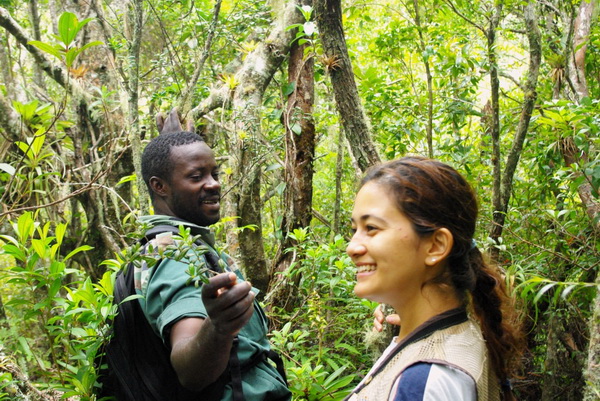
Dr. Shauna-Lee Chai in the field with Park Ranger Johnson
The same species continue to be grown in the Park’s nurseries at Holywell and Hagley Gap with efforts moving ahead to propagate other species. Planting a variety of native species promotes biodiversity and use of non-lumber species discourages illegal logging within the National Park. Species include Sapium harissii (Milkwood), Alchornea latifolia (Dovewood), Clethra occidentalis (Soapwood), Podocarpus urbanii (Mountain Yacca). 18,000 seedlings were successfully grown and planted between 2005 and 2009 and the target for 2011 – 2016 is 22,000.
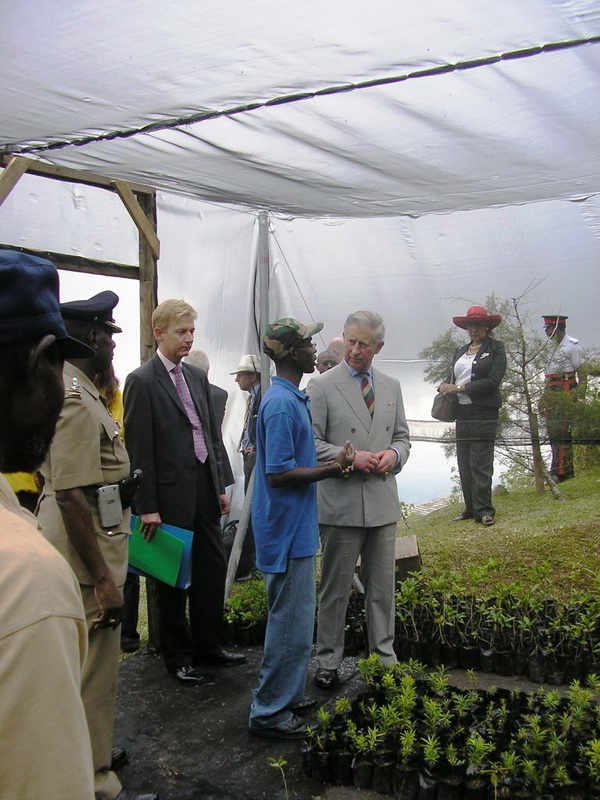
Conservation Science Officer, Marlon Beale explains to HRH the Prince of Wales,
the propagation of native seedlings at the BJCMNP nursery at Holywell
Research
Management is based on a scientific understanding of the ecosystems and their threats and requirements. Therefore, research is needed to guide management. Researchers must apply to the National Environment and Planning Agency for permission to conduct field research in Jamaica. For research proposed in the BJCMNP, the JCDT is asked to comment on the proposals. Between 2005 and 2009 Park staff accompanied 11 researchers in the field to share knowledge and reduce threats to resources. Partnerships were established with 4 research institutions and significant research was conducted and/or initiated:-
- University of the West Indies (UWI) – a variety of studies
- University of Michigan (UM) – M.Sc. project on community views and Park impact
- Humboldt University – birds and their impact on coffee pests
- Cambridge University – forest cover changes
The following highlights some of the research needs for the BJCMNP
Invasive Plants
- The distribution of Pittosporum undulatum in the Blue and John Crow Mountains National Park and Community Buffer Zone.
- Controlling P. viridiflorum, Melinus minutiflora (molasses or Wynne grass), Gleichenia sp (fern), and Polygonum chinnense (red bush) in the Blue and John Crow Mountains National Park.
- Investigating competition between invasive plant species such as (P. undulatum, P. viridiflorum, Melinus minutiflora, Gleichenia sp, Hedychium gardnerianum, Polygonum chinnense) and the native flora of the Blue and John Crow Mountains National Park.
- Investigation of possible economic uses of invasive plant species such as Wild Ginger (Hedychium sp.) and Wild Coffee/Mock Orange (Pittosporum undulatum).
Native Plants
- Propagation of endemic and threatened plant species of the Blue and John Crow Mountains National Park (can use Park nurseries)
Birds
- Bird composition in the central and eastern regions of the Blue and John Crow Mountains National Park.
- Bird composition in the Blue and John Crow Mountains below 1,000 meters.
- Status of the range expanding Shiny cowbird in the Blue and John Crow Mountains National Park.
- Population status of the Jamaican Blackbird in the Blue and John Crow Mountains National Park.
- Population estimates of key native (particularly endemics) and migrant bird species
Hutia
- Demographic and Ecological Studies on the Jamaican Hutia (Geocapromys browneii) in the Blue and John Crow Mountains National Park. In particular, the status and impact of hunting on populations, and the possible use of captive breeding and release as a conservation strategy.
Invertebrates
- A taxonomic survey of the insects found in the Blue and John Crow Mountains National Park.
- Investigation of potential bio-indicators of ecosystem health in the Blue and John Crow Mountains National Park.
- Demographic study of the Giant Swallowtail Butterfly (Papilio homerus)
- Demographic and ecological study of Land crabs in the BJCMNP
- A taxonomic survey of the aquatic invertebrates found in the rivers and streams of the Blue and John Crow Mountains.
- Taxonomic and ecological study of the fauna of bromeliads in the BJCMNP
Ecology
- Ecological studies of conservation targets and other species within the Blue and John Crow Mountains National Park, with particular emphasis on specific threats and conservation management requirements.
Agriculture
- The distribution, size, growth and shrinking rate of coffee farms in and around the Blue and John Crow Mountains National Park.
- Harvesting non timber forest resources - resource dynamics and resource users
Forest Ecology and Forestry
- Silvicultural requirements and suitability of some indigenous tree species on farmland areas around the Blue and John Crow Mountains
- The survival and growth rates of young indigenous trees in open agricultural areas around the Blue and John Crow Mountains National Park.
- Species composition in forest soil seed banks of the Blue and John Crow Mountains National Park.
- Habitat assessment of the upper montane rainforest over limestone on John Crow peak
- Habitat assessment of the Montane Summit Savanna and Riparian communities in the Blue and John Crow Mountains National Park.
- Assessment of species on the northern slopes of the Blue Mountains, particularly bryophytes and lichens.
- The effect of forest clearance on soil fertility and productivity and water yield.
- Updated forest and wildlife inventory
Communities and Socio-economic Issues
- The impact of buffer zone communities on the Blue and John Crow Mountains National Park, including issues related to demographic changes.
- Analysis of participatory approaches to natural resources management in the Blue and John Crow Mountains National Park.
- Analysis of old enforcement and natural resource log books to establish trends and comparison with more current, geographical and electronic observation data, to identify any changes in the threats to the Park and to guide management approaches.
- Impact of wild hog hunting on the ecological integrity of the BJCMNP.
- Studies and pilot projects on sustainable harvesting and use of natural resources e.g. wicker, insects.
- Studies and pilot projects on growing of native plant species e.g. orchids, and farming of animal species e.g. Giant Swallowtail Butterfly for revenue generation.
Maroon Cultural Heritage
- Clarification of Maroon communal land location in relation to the Blue and John Crow Mountains National Park. The location is believed to be outside the Park boundary but the exact location is uncertain.
- Further archaeological research at Nanny Town in the Blue and John Crow Mountains National Park.
- Growing of plants e.g. Cacoon, Thatch Palm, medicinal herbs, relevant to Maroon heritage, to ensure their conservation and sustainable harvesting.
Recreation
- Estimate of carrying capacity and development of Limits of Acceptable Change Monitoring and Visitor Impact Management Systems particularly in the BJCMNP recreation areas – Holywell, Blue Mountain Peak Trail and Cunha Cunha Pass Trail, but possibly also for Buffer Zone Community attractions e.g. Cascade Waterfall.
- A study on trails within the Park and its Community Buffer Zone to identify trails suitable for development, management and monitoring requirements, based on ecological, environmental and other assessments.
Other
- Analysis of hazard vulnerability within the Blue and John Crow Mountains National Park, and identification and mapping of areas for special management.
- Climate change and its impacts on the BJCMNP, especially flora and fauna (can use data from Park monitoring) Aim to make recommendations for action.
- Study on potential mining in the Park, and its ecological, environmental, social and economic impacts including cost/benefit analysis which considers the ecosystem services the Park provides.
BJCMNP Conservation Targets
The National Park has 8 conservation targets; however due to limited information regarding specific conservation requirements and based on the knowledge that habitat is critical and that loss of habitat is a major threat to biodiversity, management focuses on protection and rehabilitation of montane forest particularly on shale where it is most threatened.
BJCMNP Conservation Targets
| Conservation Target | Target Justification |
|---|---|
| montane forest on shale | Blue Mountain forest ecosystem with over 40% plant endemism, many with a threatened status. Contracting forest habitat for dependent wildlife. |
| montane forest on limestone | John Crow Mountain forest ecosystem and Blue Mountain limestone outcrops with high plant endemism, many with a threatened status. Contracting forest habitat for dependent wildlife. |
| epiphytic communities | Major grouping of plants, including many endemic and highly threatened orchids and bromeliads, the latter of which are important habitats for many of our endemic species of Eleutherodactylus frogs. |
| headwater ecosystems | Vital headwater ecosystems that supply water to eastern Jamaica, and cover 10 watershed management units. |
| montane forest birds | Major grouping of native and migrant species. Natives with a high level of endemism and similar conservation requirements. |
| Jamaican Coney | Last remaining native, non-volant mammalian species high in the food chain. It is vulnerable and endemic. |
| Yellow Snake | Large, vulnerable, reptilian, endemic species often killed on sight by local people. |
| Giant Swallowtail Butterfly | Endangered, endemic, flagship species affected by illegal trade. |
| Programme Goal To maintain and enhance the appreciation for, and practice of the Maroon heritage associated with the Blue and John Crow Mountains. | |
|---|---|
| Objective 1 | To facilitate the conservation of the tangible cultural heritage of the Windward Maroons |
| Objective 2 | To facilitate the preservation of the intangible cultural heritage of the Windward Maroons |
| Objective 3 | To promote awareness and appreciation of the intangible cultural heritage of the Windward Maroons, and its connection to the natural heritage of the BJCM |
| Objective 4 | To promote research that will inform park management, but will not threaten conservation of the BJCMNP’s cultural heritage |
| Objective 5 | To establish and protect the Intellectual Property Rights of the Maroon people |
Prior to the 2011 Management Plan, cultural heritage preservation was not clearly defined and was to be accomplished through other programmes e.g. Recreation and Tourism. Despite this, a significant amount was achieved through involvement of the Charles Town and Moore Town Maroons as well as Maroon descendants in the Rio Grande Valley in the preparation of a Blue Mountains Sustainable Tourism Programme. Further, the research collated during the preparation of the UNESCO World Heritage Site Nomination, provided the basis for the development of a focused cultural heritage programme for the Blue and John Crow Mountains National Park.
Much of the material or tangible heritage of the Windward Maroons has been lost due to the types of natural materials they used and the tendency for camps prior to the Peace Treaty being of a temporary nature. The trails e.g. Cunha Cunha Pass Trail and place names e.g. Dinner Time, still remain. So does the intangible heritage such as songs, drumming, dancing and language in addition to the knowledge of making various items e.g. baskets, foods e.g. Cacoon stew and medicines from a variety of herbs.
Between 2011 and 2016, the JCDT working together with the Maroon Councils, the Jamaica National Heritage Trust and the African Caribbean Institute of Jamaica (ACIJ) will aim to move towards achievement of the above-mentioned objectives.
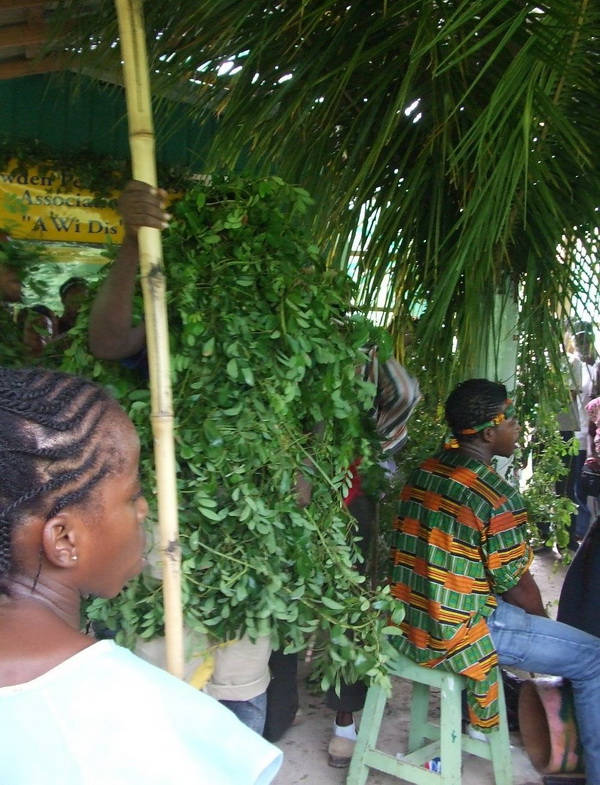
Re-enactment of “Ambush” by Maroons from Cornwall Barracks
| Programme Goal To stop encroachment of the BJCMNP boundary and destruction of the forest and wildlife within | |
|---|---|
| Objective 1 | To increase the level of presence of enforcement officers and their effectiveness in detecting and mitigating breaches of relevant legislation |
| Objective 2 | To contribute to the resolution of breaches inclusive prosecution of offenders |
| Objective 3 | To resolve boundary discrepancies and re-establish and mark all boundaries. |
| Objective 4 | To raise community awareness regarding: the BJCMNP boundary and legislation, particular issues that threaten the BJCMNP, and increase community involvement in addressing these issues. |
Between 2005 and 2009, the number of National Park Ranger patrols doubled:
| Year | Number of Patrols |
|---|---|
| 2005 | 43 |
| 2006 | 80 |
| 2007 | 120 |
| 2008 | 175 |
| 2009 | 100 |
Unfortunately, due to funding and other challenges e.g. resignation of staff to move on to other positions, the numbers of patrols began to decline again. During the current Management Plan period efforts are being made to increase the number of patrols and to stabilize the programme. This is important as during the period of increased patrols, there was clearly a decline in illegal activity. The current Management Plan recommends between 12 – 15 Park Rangers based on international studies conducted by Bruner et. al. (2001).
The National Park Regulations of 1993, section 32, state the functions of a National Park Ranger as, “to patrol the area of each national park, to protect the resources of that national park and without prejudice to the generality of the foregoing, to-
- patrol and monitor the various zones of the national park;
- enforce these Regulations;
- maintain patrol vehicles, marking facilities and trails;
- provide first-aid, emergency or rescue assistance to national park users in the event of accident or injury; and
- assist in the conduct of environmental monitoring programmes”.
This is exactly what the BJCMNP Rangers do – they are involved in all aspects of National Park management, including encouraging compliance through interpretive enforcement.
In 2005, the Rangers began to use GPS units to map their exact location on patrol using geographical information that could be uploaded on to maps of the National Park once the Rangers returned to headquarters. They also take photographs and notes of their observations. This information is used to guide the Enforcement and Compliance Programme in regard to further action to reduce breaches of legislation.
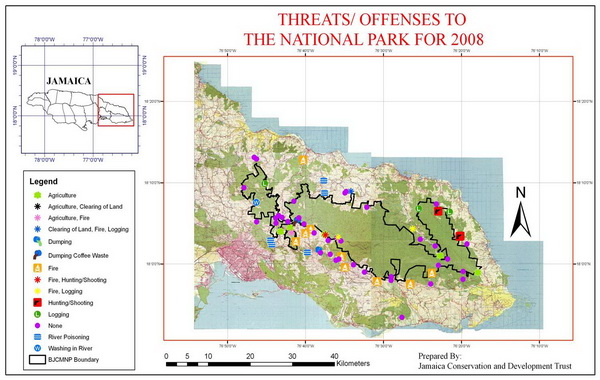
Map showing threats and/or illegal activities in and around the National Park boundary, observed by Park Rangers on patrol during 2008
Illegal activities and threats to the National Park’s ecosystems are reported to the relevant government agency (National Environment and Planning Agency and/or Forestry Department) and action taken accordingly.
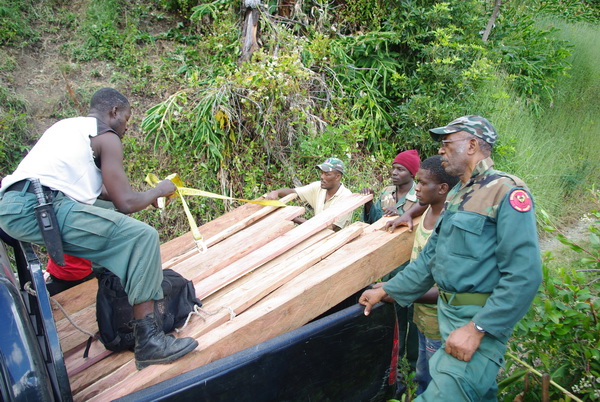
Confiscation of Juniper Cedar stolen from within the National Park