Blue & John Crow Mountains
|
PROGRAMME GOAL To raise support for conservation of the BJCMNP’s natural and cultural heritage and improve resource management and the sustainability of livelihoods, particularly in Buffer Zone communities. |
|
Target Groups
Group 1: Communities (particularly resource users) around the park. They include farmers, community-based organizations such as citizens, churches, schools, youth and women’s groups; and business entities such as shops and business interests in coffee, spring water and tourism.
Group 2: Schools (teachers and students) around the park, in eastern Jamaica and the rest of the island.
Group 3: Visitors (to the Park’s and Buffer Zone’s recreation areas.
Group 4: The wider public including businesses and government agencies.
Prior to 2000, education and sustainable livelihoods training in the BJCMNP was community oriented, and implemented by the Rangers through “interpretive enforcement” or specific projects. After 1996, there was an increased focus on schools in the Buffer Zone communities. In 2003, with the Youth PATH project, the focus broadened from just community schools to community youth (who had left school) and by 2004, attention to community adults began to increase again. This was particularly influenced by the recognition that whilst environmental education in schools was important in order to encourage environmental conservation in successive generations, children and youth were not directly responsible for the threats to the Park. In addition an assessment conducted indicated the need to target community adults.
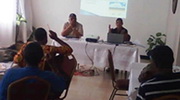
The period 2011 to 2016 will continue to have multiple targets as visits to community schools and visits of Kingston schools to Holywell continue in addition to building of community capacity for environmental management and sustainable development. For example, in 2011 about 20 persons from 6 communities participated in a 2 day business planning training workshop and 3 community groups were assisted in developing business plans for their community tourism ventures.
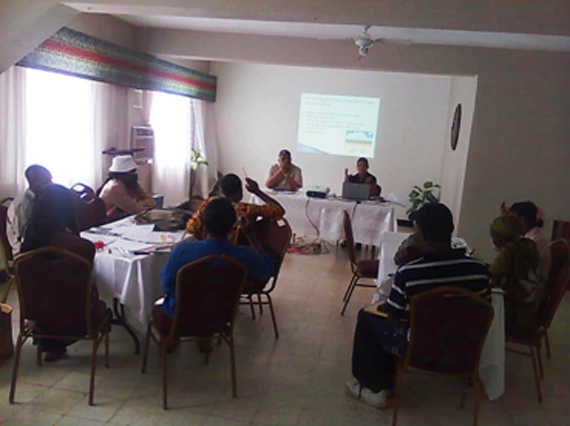
Business planning training workshop in Port Antonio
Highlights of community education for 2005 – 2009 were:
- facilitation of sustainable agriculture training for over 75 community members, particularly in organic farming, soil conservation and green-house agriculture.
- agro-forestry or sustainable agriculture projects in 3 communities (Millbank, Woodford/Freetown and Cascade/Section).
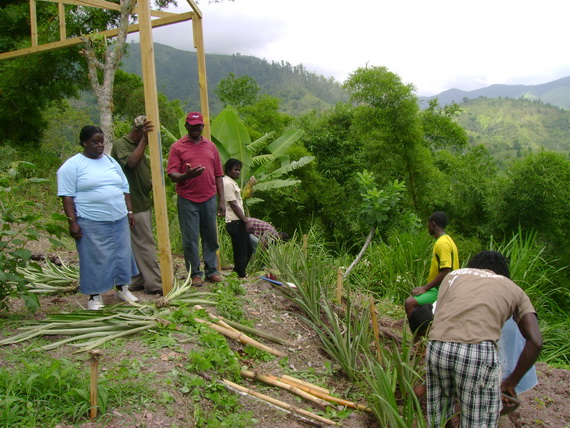
Planting of pineapples to reduce soil erosion beside greenhouse being built at Cascade to reduce slash and burn farming practices
- Almost 200 community members attended community meetings in 8 communities to raise awareness about a variety of issues including the Yellow Snake (Jamaican Boa) and Fires.
- Over 200 people from 8 communities in the Upper Rio Grande Valley attended “town square” meetings regarding the illegal and harmful use of pesticides for catching crayfish.
- Interpretation at Holywell improved significantly particularly with the establishment of the Kids Discovery Zone and development of educational packages for primary level students. With marketing, the number of schools visiting for booked packages moved from 7 (500 students) in 2006 to 41 (over 2,500 students) in 2009.
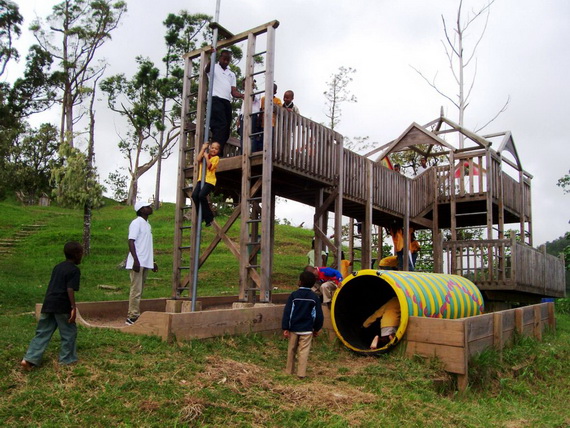
School group playing at the Kids Discovery Zone, Holywell
- The number of buffer zone community schools visited annually was increased from 25 to 37, with the inclusion of basic schools (4 – 6 year olds) as well as primary and all age schools (10 – 12 year olds). Involvement of Youth PATH members and Park Rangers also facilitated this increase in the number of schools, by increasing the human resources addressing the programme.
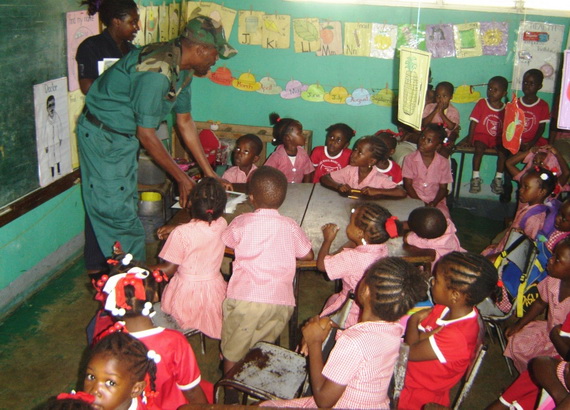
Ranger Poyser and Youth PATH member make a presentation at a basic school
| Programme Goal To provide and facilitate the provision of recreational opportunities for local and international visitors using ecotourism principles in order to generate income and support for the BJCMNP. | |
|---|---|
| Objective 1 | To provide and facilitate recreational and educational opportunities geared at raising awareness and support of the BJCMNP, as per existing plans. |
| Objective 2 | To generate income to support park management by increasing income from the BJCMNP’s recreational areas and the Blue Mountains Sustainable Tourism Programme by 150% over the five years. |
| Objective 3 | To engender community support for the BJCMNP as well as natural and cultural heritage conservation by facilitating benefits to local communities. |
| Objective 4 | To ensure that recreation and tourism activities do not threaten the BJCMNP’s biodiversity, provision of ecosystem services and cultural heritage. |
The National Park’s main recreational areas are at Holywell and the Blue Mountain Peak Trail. However, there has been an increased focus over the years on community tourism. The focus for 2011 to 2016 will be to obtain the funds to implement the Blue Mountains Sustainable Tourism Programme which will result in achievement of all the objectives of the BJCMNP Recreation and Tourism Programme.
Between 2005 and 2010, Holywell infrastructure suffered from the negative impact of hurricanes and tropical storms in 2007 and 2008 (having also suffered damage in 2004). This is partly due to the location of the site in the Hardware Gap between the Port Royal and Blue Mountains in addition to the numerous trails all of which funnel hurricane force winds and result in damage to trees (particularly the non-native trees still remaining at Holywell) and buildings. Based on the preparation and implementation of the EMS, Holywell obtained Green Globe certification in 2005, however Park management was unable to maintain the certification due to the costly fees (for auditing and membership).
Despite this, recreational and educational opportunities were increased and improved over the period e.g. the Kids Discovery Zone and the development of educational packages for schools. Further, community-based organisations such as the Bowden Pen Farmers Association and Charles Town Maroon Council were assisted in improving and expanding the opportunities available within their communities, thus broadening the type of experiences available to visitors. Of note, facilitation of sustainable tourism training for over 125 community members, particularly raising awareness and knowledge about the BJCMNP, basic tourism and hospitality training through the nationally accredited TEAM JAMAICA programme (50 certified) and TPDCo. Tour Guide training (23 certified). The ecotourism approach used, in particular with respect to facilitating benefits to local communities, resulted in community support for the Park, as reflected in volunteerism and interest shown by community members in Park activities and events. Of special note, was the training of youth from around Holywell to assist with educational packages, allowing the youth to generate some income for themselves whilst helping the Park. Visitors to Holywell in particular showed interest and several made cash donations or provided other forms of support to Park management.
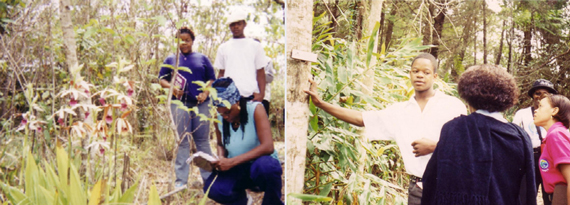
Community youth learn about natural heritage at Holywell
Improvements were made to the Waterfall Trail and to interpretation in the picnic areas in 2010.
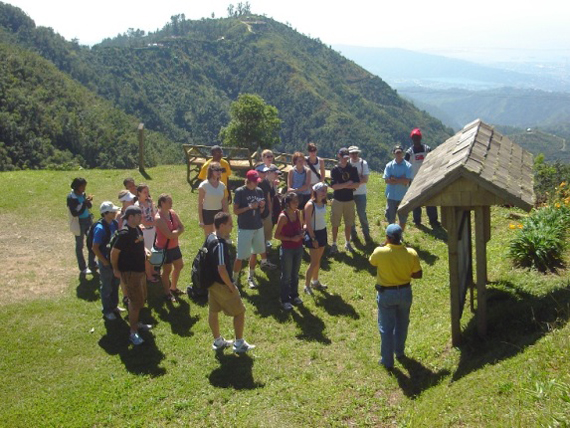
Ranger Dawes conducts orientation before starting the Oatley Mountain Trail
| Programme Goal To provide and facilitate the provision of recreational opportunities for local and international visitors using ecotourism principles in order to generate income and support for the BJCMNP | |
|---|---|
| Objective 1 | To track, record and mitigate threats to the BJCMNP, posed by use of its resources |
| Objective 2 | To monitor the populations of key, threatened species – the Giant Swallowtail Butterfly, the Jamaican Coney and the Yellow Boa. |
| Objective 3 | To monitor forest area and encroachment activities. |
| Objective 4 | To monitor the quality of fresh water ecosystems in the BJCMNP. |
| Objective 5 | To monitor the bird distribution in the BJCMNP. |
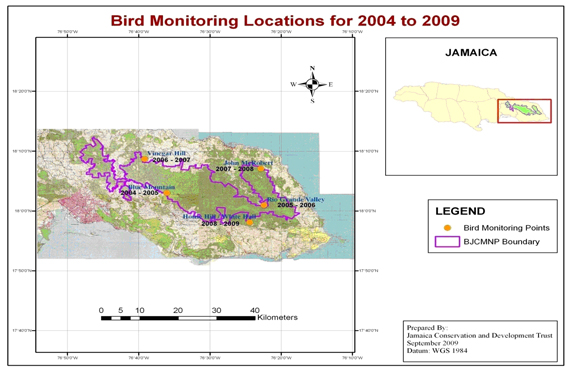
The BJCMNP is now in its second five year cycle of bird monitoring of five sites around the National Park.
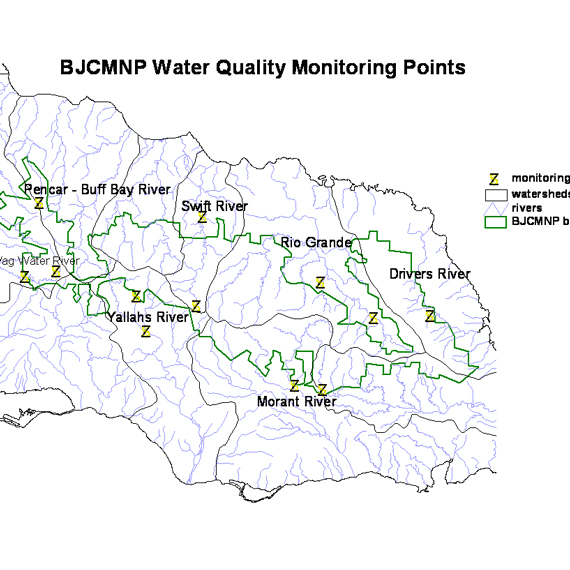
Monitoring of streams (temperature, turbidity, oxygen and macro-invertebrates) is conducted at 12 sites within and just outside the National Park boundary.
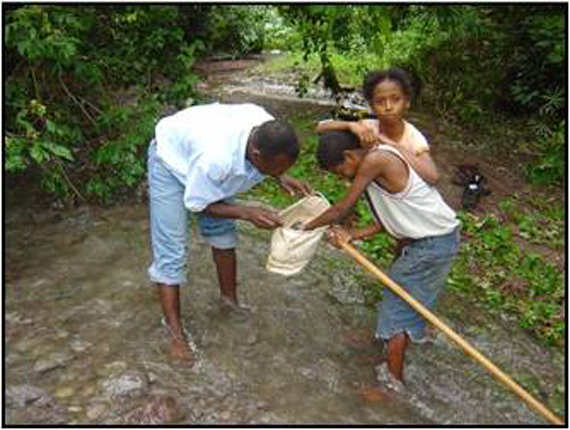
Curious children investigate what Ranger Love has caught in the kick-net
Monitoring also includes annual photo-monitoring of particular vistas to compare conditions over the years. Monitoring refers to the intermittent (regular or irregular) surveillance carried out to ascertain compliance with a predetermined standard and to investigate the degree of deviation from an expected norm. Monitoring provides the information by which projects and programmes may be evaluated. Annual reports are prepared and every five years, an assessment of the Park’s success in achieving its objectives is conducted.
To meet the BJCMNP’s over-arching conservation goal and execute the management programmes aimed at achieving this, several management and administrative functions are essential. Planning, project management, supervision, financial management, monitoring and evaluation are all critical management functions that ensure timely and effective implementation of activities. Financial management is of particular significance in the Jamaican context where funding from government sources is limited and un-secured. Administrative functions include procurement, accounting, reporting, filing and correspondence. Administrators and the work they do, often behind the scenes, provides the necessary support that operations staff need to get the mission of the organization accomplished. Marketing and public relations activities are necessary, not only for the recreation and tourism components of park management, but to promote the National Park’s work in order to garner increased support.
| Programme Goal To provide efficient, effective and sustained management that will allow the BJCMNP to meet its over-arching and other goals. | |
|---|---|
| Objective 1 | To coordinate management at the policy level through establishment of a BJCMNP Advisory Committee comprising key public, private sector and community stakeholders meeting twice a year. |
| Objective 2 | To coordinate management at the operations level through regular meetings of the Co-Management Committee (management partners as per relevant agreements) and community stakeholders. |
| Objective 3 | To provide supervision, project management, financial management and administrative support for the BJCMNP’s programmes |
| Objective 4 | To source short and long-term funding for park management through grant funding, government subvention, donations, sponsorship and opportunities provided through the Recreation and Tourism Programme. |
| Objective 5 | To ensure adaptive management through monitoring and evaluation of all programmes |