Articles
- BJCMNP Management Programmes
- Natural Heritage Conservation Programme
- Cultural Heritage Preservation Programme
- Enforcement and Compliance Programme
- Education and Public Involvement Programme
- Recreation and Tourism Programme
- Monitoring and Evaluation Programme
- Governance and Administration Programme
- All Pages
Education and Public Involvement Programme
|
PROGRAMME GOAL To raise support for conservation of the BJCMNP’s natural and cultural heritage and improve resource management and the sustainability of livelihoods, particularly in Buffer Zone communities. |
|
Target Groups
Group 1: Communities (particularly resource users) around the park. They include farmers, community-based organizations such as citizens, churches, schools, youth and women’s groups; and business entities such as shops and business interests in coffee, spring water and tourism.
Group 2: Schools (teachers and students) around the park, in eastern Jamaica and the rest of the island.
Group 3: Visitors (to the Park’s and Buffer Zone’s recreation areas.
Group 4: The wider public including businesses and government agencies.
Prior to 2000, education and sustainable livelihoods training in the BJCMNP was community oriented, and implemented by the Rangers through “interpretive enforcement” or specific projects. After 1996, there was an increased focus on schools in the Buffer Zone communities. In 2003, with the Youth PATH project, the focus broadened from just community schools to community youth (who had left school) and by 2004, attention to community adults began to increase again. This was particularly influenced by the recognition that whilst environmental education in schools was important in order to encourage environmental conservation in successive generations, children and youth were not directly responsible for the threats to the Park. In addition an assessment conducted indicated the need to target community adults.
The period 2011 to 2016 will continue to have multiple targets as visits to community schools and visits of Kingston schools to Holywell continue in addition to building of community capacity for environmental management and sustainable development. For example, in 2011 about 20 persons from 6 communities participated in a 2 day business planning training workshop and 3 community groups were assisted in developing business plans for their community tourism ventures.
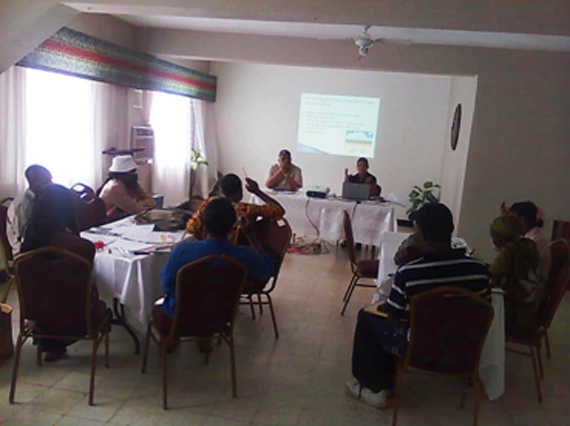
Business planning training workshop in Port Antonio
Highlights of community education for 2005 – 2009 were:
- facilitation of sustainable agriculture training for over 75 community members, particularly in organic farming, soil conservation and green-house agriculture.
- agro-forestry or sustainable agriculture projects in 3 communities (Millbank, Woodford/Freetown and Cascade/Section).
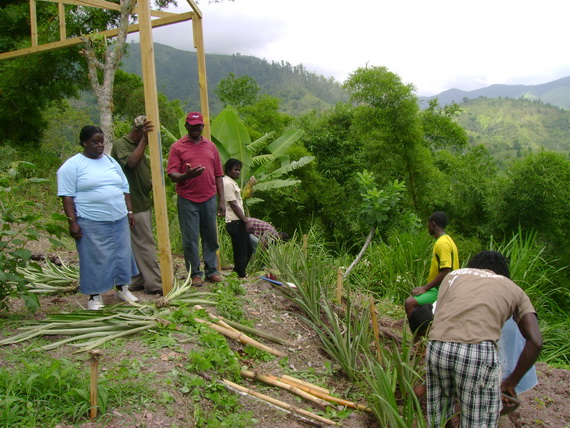
Planting of pineapples to reduce soil erosion beside greenhouse being built at Cascade to reduce slash and burn farming practices
- Almost 200 community members attended community meetings in 8 communities to raise awareness about a variety of issues including the Yellow Snake (Jamaican Boa) and Fires.
- Over 200 people from 8 communities in the Upper Rio Grande Valley attended “town square” meetings regarding the illegal and harmful use of pesticides for catching crayfish.
- Interpretation at Holywell improved significantly particularly with the establishment of the Kids Discovery Zone and development of educational packages for primary level students. With marketing, the number of schools visiting for booked packages moved from 7 (500 students) in 2006 to 41 (over 2,500 students) in 2009.
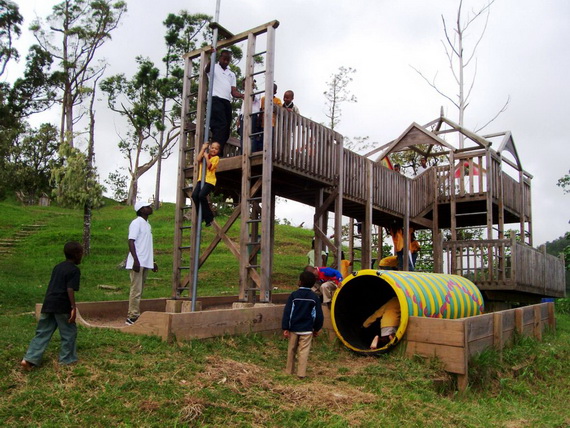
School group playing at the Kids Discovery Zone, Holywell
- The number of buffer zone community schools visited annually was increased from 25 to 37, with the inclusion of basic schools (4 – 6 year olds) as well as primary and all age schools (10 – 12 year olds). Involvement of Youth PATH members and Park Rangers also facilitated this increase in the number of schools, by increasing the human resources addressing the programme.
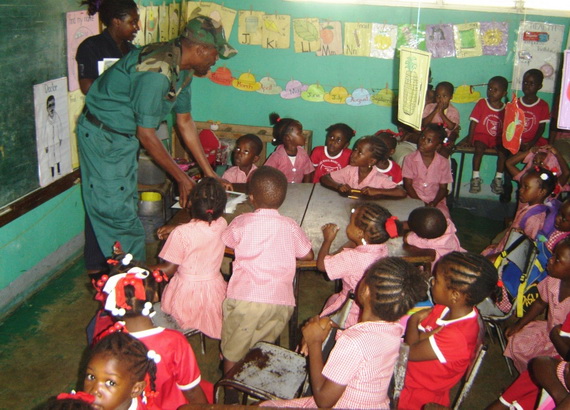
Ranger Poyser and Youth PATH make a presentation at a basic school